
Introduction
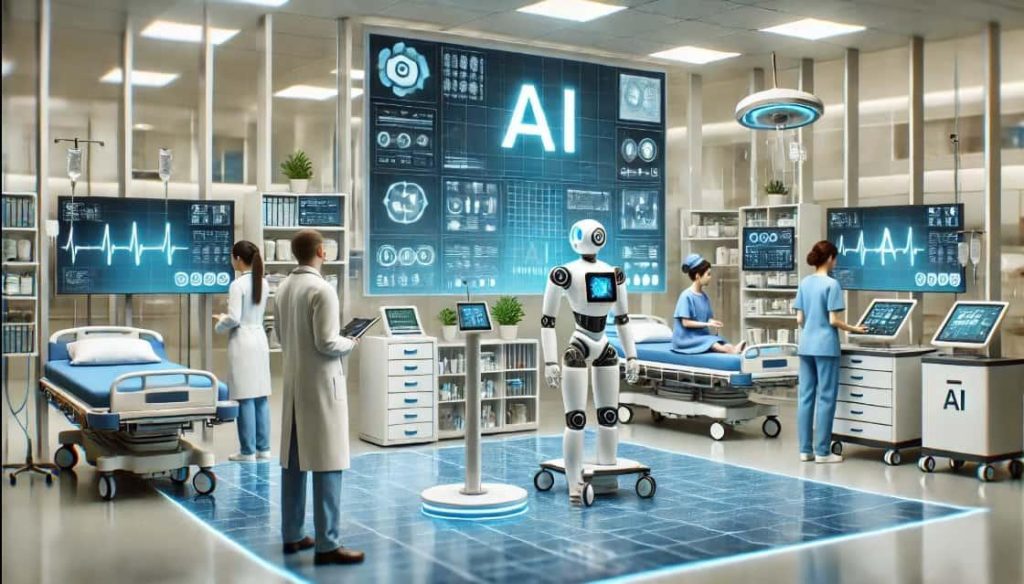
Artificial Intelligence (AI) is revolutionizing healthcare by changing how diseases are diagnosed, treatments are planned, hospitals are managed, and patients receive care. What once seemed like science fiction is now becoming an essential part of modern medicine.
Healthcare organizations worldwide are adopting AI to improve accuracy, reduce costs, accelerate research, and provide better patient outcomes. From intelligent medical imaging systems to virtual health assistants and robotic surgeries, AI is helping doctors and healthcare professionals make faster, more informed decisions.
The healthcare industry generates enormous amounts of data every day. AI can analyze this information far more efficiently than traditional methods, allowing medical teams to detect patterns, predict risks, and personalize treatments.
In this comprehensive guide, we’ll explore how AI is transforming healthcare, its major applications, benefits, challenges, ethical considerations, and what the future holds for AI-powered medicine.
What Is AI in Healthcare?
AI in healthcare refers to the use of artificial intelligence technologies to assist medical professionals, hospitals, researchers, and healthcare organizations.
These technologies include:
- Machine Learning
- Deep Learning
- Natural Language Processing
- Computer Vision
- Predictive Analytics
- Robotics
AI systems analyze medical data to support diagnosis, treatment planning, patient monitoring, and healthcare management.
Rather than replacing healthcare professionals, AI serves as an intelligent assistant that improves decision-making and operational efficiency.
Why AI Is Important in Healthcare
Healthcare systems face many challenges, including:
- Growing patient populations
- Staff shortages
- Rising treatment costs
- Increasing medical data
- Complex disease management
Artificial intelligence helps address these challenges by automating repetitive tasks, improving diagnostic accuracy, and supporting clinical decision-making.
Major benefits include:
- Faster diagnoses
- Reduced medical errors
- Personalized treatments
- Improved hospital efficiency
- Better patient outcomes
How AI Works in Healthcare
AI systems learn from large amounts of medical information, including:
- Electronic health records
- Medical images
- Laboratory reports
- Clinical research
- Genomic data
- Wearable device information
After analyzing these datasets, AI can identify patterns that help healthcare professionals make more informed decisions.
The accuracy of AI systems continues improving as more high-quality medical data becomes available.
Major Applications of AI in Healthcare
1. Disease Diagnosis
One of AI’s most valuable applications is assisting with disease diagnosis.
AI can analyze:
- X-rays
- CT scans
- MRI scans
- Blood test results
- Pathology images
This enables earlier detection of diseases such as cancer, heart conditions, and neurological disorders.
Early diagnosis often leads to better treatment outcomes.
2. Medical Imaging
Medical imaging generates enormous amounts of data.
AI helps radiologists by:
- Detecting abnormalities
- Highlighting suspicious areas
- Improving image interpretation
- Reducing diagnostic time
Rather than replacing radiologists, AI provides decision support that increases efficiency and consistency.

3. Personalized Medicine
Every patient is unique.
AI helps create personalized treatment plans based on:
- Medical history
- Genetics
- Lifestyle
- Existing conditions
- Medication responses
Personalized healthcare improves treatment effectiveness while reducing unnecessary interventions.
4. Drug Discovery
Developing new medicines traditionally requires many years.
AI accelerates the process by:
- Analyzing chemical compounds
- Identifying potential drug candidates
- Predicting effectiveness
- Supporting clinical research
This reduces development costs and shortens research timelines.
5. Robotic Surgery
AI-powered robotic systems assist surgeons by providing greater precision during complex procedures.
Advantages include:
- Smaller incisions
- Reduced blood loss
- Faster recovery
- Improved surgical accuracy
Human surgeons remain in control while AI enhances precision.
AI in Hospital Management

Hospitals manage thousands of daily operations.
AI helps optimize:
- Appointment scheduling
- Patient flow
- Staff allocation
- Inventory management
- Resource planning
Efficient hospital operations improve both patient experiences and healthcare outcomes.
AI in Patient Monitoring
Wearable devices continuously collect health information.
AI analyzes:
- Heart rate
- Blood pressure
- Blood glucose
- Sleep quality
- Physical activity
Continuous monitoring allows earlier detection of health issues.
Healthcare providers can intervene before conditions become severe.
AI and Virtual Healthcare Assistants
AI-powered assistants help patients by:
- Answering medical questions
- Scheduling appointments
- Sending medication reminders
- Providing health education
These systems improve accessibility while reducing administrative workloads.
AI in Medical Research
Medical researchers process vast amounts of scientific information.
AI helps by:
- Identifying research patterns
- Reviewing literature
- Predicting outcomes
- Supporting clinical trials
Researchers can make discoveries more efficiently using AI-powered analysis.
Benefits of AI in Healthcare
Improved Diagnostic Accuracy
AI reduces the likelihood of missed diagnoses.
Faster Treatment
Healthcare providers receive timely insights.
Lower Costs
Automation reduces administrative expenses.
Better Patient Outcomes
Earlier detection improves recovery rates.
Increased Efficiency
Healthcare professionals spend more time with patients and less on repetitive tasks.
Challenges of AI in Healthcare
Despite its potential, AI presents several challenges.
Data Privacy
Medical records contain sensitive personal information.
Healthcare organizations must protect patient privacy.
Bias
AI systems depend on training data.
Poor-quality or unrepresentative data can introduce bias.
Regulatory Compliance
Healthcare AI must comply with strict regulations and safety standards.
Human Oversight
AI should support—not replace—medical professionals.
Clinical decisions should always involve qualified healthcare providers.
AI and Medical Ethics
Responsible AI requires:
- Transparency
- Fairness
- Privacy protection
- Accountability
- Human oversight
Ethical development ensures AI benefits patients while minimizing risks.
AI in Mental Healthcare
Artificial intelligence also supports mental health services.
Applications include:
- Mood monitoring
- Therapy support
- Behavioral analysis
- Risk identification
AI can expand access to mental healthcare while supporting clinicians.
AI and Telemedicine
Telemedicine has grown rapidly.
AI enhances remote healthcare by:
- Screening symptoms
- Prioritizing urgent cases
- Supporting virtual consultations
- Monitoring chronic conditions
This improves healthcare accessibility, especially in remote areas.
AI and Medical Education
Medical students benefit from AI through:
- Interactive learning
- Clinical simulations
- Personalized study plans
- Knowledge assessments
AI enhances education while helping future healthcare professionals develop essential skills.
Future of AI in Healthcare
Artificial intelligence will continue transforming medicine.
Future developments may include:
- Fully personalized healthcare
- Predictive disease prevention
- Advanced robotic surgeries
- Faster vaccine development
- Intelligent hospital systems
- Precision diagnostics
Healthcare will become increasingly proactive rather than reactive.
AI for Healthcare Businesses
Healthcare organizations can use AI to:
- Improve operational efficiency
- Enhance patient satisfaction
- Reduce administrative workloads
- Optimize financial performance
- Strengthen decision-making
Organizations adopting AI strategically are likely to gain long-term advantages.
Learn More About AI
If you’re interested in artificial intelligence, technology, digital innovation, blogging, and business trends, explore:
B2Blogs publishes informative articles covering AI, technology, productivity, and digital transformation.
AI and Healthcare Documentation
Healthcare professionals frequently manage medical reports, research papers, and PDF documents.
For PDF-related productivity resources and document workflow solutions, visit:
PDFBirds provides helpful tools for document management, conversion, and digital productivity.
Preparing for the Future
Healthcare professionals should:
- Learn AI fundamentals
- Understand ethical guidelines
- Develop digital skills
- Embrace collaboration with AI technologies
The future of healthcare depends on effective partnerships between human expertise and intelligent systems.
Conclusion
Artificial intelligence is transforming healthcare in remarkable ways. From improving diagnostic accuracy and accelerating drug discovery to supporting robotic surgery and enhancing patient care, AI is becoming an indispensable part of modern medicine.
While challenges such as privacy, regulation, and ethics require careful attention, the opportunities are far greater. AI enables healthcare professionals to make better decisions, improve efficiency, and provide more personalized care.
The future of healthcare will not be driven solely by machines or humans but by collaboration between both. Organizations, professionals, and patients who embrace responsible AI innovation will be well-positioned to benefit from safer, smarter, and more effective healthcare systems.
FAQ
What is AI in healthcare?
AI in healthcare refers to using artificial intelligence technologies to assist with diagnosis, treatment planning, medical research, patient monitoring, and hospital operations.
What are the benefits of AI in healthcare?
AI improves diagnostic accuracy, enhances patient care, reduces administrative workloads, supports medical research, and increases hospital efficiency.
Can AI replace doctors?
No. AI is designed to support healthcare professionals by providing decision assistance and automation. Medical expertise and human judgment remain essential.
What is the future of AI in healthcare?
Future developments include personalized medicine, predictive healthcare, intelligent hospital systems, advanced medical imaging, and faster drug discovery.
SEO Keywords
- AI in Healthcare
- Artificial Intelligence in Healthcare
- AI Medical Technology
- AI Healthcare Applications
- AI Diagnosis
- AI Medical Imaging
- AI in Medicine
- AI Patient Care
- Future of Healthcare
- Healthcare Innovation
Suggested Internal Links
- Future of Artificial Intelligence
- AI Tools for Small Businesses
- Best AI Image Generators
- How AI is Changing Content Creation
- Best Free AI Writing Tools